York rendering guide
Can a lime-render repair blend into an existing finish?
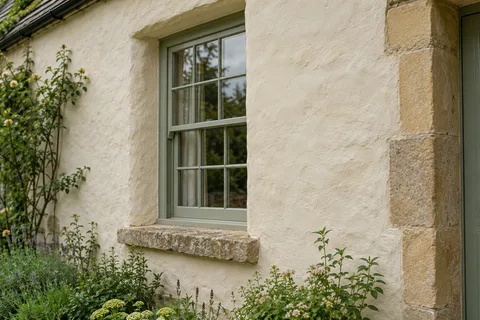
A lime render repair sits beside old work with its own texture, colour and history. The first aim is a repair that suits the wall: lime, not cement, built up and cured properly. How it looks beside the old render is the second question, and the answer depends on colour, texture, level and the finish that goes over both.

On this page
Four differences that can make a patch visible
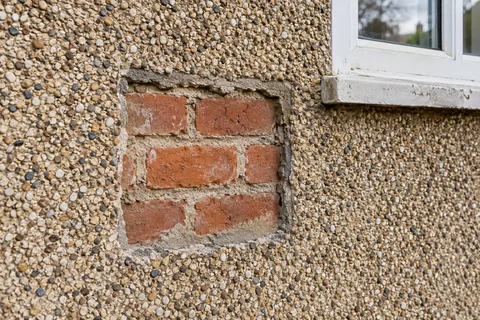
A patch can differ from the surrounding wall in colour, grain, surface level or edge shape. Those differences can coexist, but they are not corrected by the same action. A wider decorative treatment concerns the colour of a larger surface. It does not change an unwanted step at the repair edge or reproduce a worn texture beneath the paint.
Imagine a new repair that has the accepted material and colour but looks conspicuous when sunlight crosses the wall. The issue may be the shape of the surface rather than the colour reference. In a second illustrative case, the texture and level look convincing but the fresh patch is noticeably brighter than the aged area. The visual question is different even though both owners might say the patch does not match.
Describing the difference precisely prevents an endless cycle of colour adjustments to solve a problem of shape. It also makes a sample more useful: the owner and contractor can concentrate on the aspect that remains unresolved rather than rejecting the entire proposal without explanation.
| Consider | Why |
|---|---|
| Background compatibility | Appearance is not the only criterion |
| Texture | Shows the relationship to retained work |
| Decoration | Influences the final colour and moisture behaviour |
| Viewing distance | Avoids judging only a magnified patch |
| Expected variation | Clarifies the intended result |
Matching the material first
IHBC is clear that cement and strong hydraulic lime should never be used to patch weak historic lime; the repair should be a matching lime. SPAB adds that replacement lime render should be weaker and more permeable, without cement, and advises against strong hydraulic limes.
Ready-mixed lime renders come in a fixed natural colour: K Rend describes its K Lime range as an off-white. Old render on a York wall may be darker, sandier or greyer, depending on the sand and lime used when it was made. A sample of the old render, broken open, shows its true colour and grain better than the weathered surface.

Texture and level
Texture comes from the finishing coat and how it is worked. K Rend's K Lime Finishing 112 is floated for a fine finish, while its lime roughcast is mixed with 4–8mm limestone chips. An old wall may have a float finish worn smooth, a thrown roughcast, or patches of both. The repair should be finished to match the area around it, not to a standard texture.
Level matters as much as colour. Lime Green treats a deviation of about 5mm under a 2m straight edge as the limit that one or two coats can correct, and old walls rarely sit flat. A patch ruled dead flat on an undulating wall will catch the light. A patch that follows the line of the wall, and stops at the same thickness as the old render, shows far less.
Curing changes the look
Fresh lime looks darker while wet and lightens as it dries, so judge a repair only when it has dried out. Cornish Lime's curing guidance is to keep fresh lime under hessian for at least two weeks and protect it from fast drying, which also helps it dry evenly rather than in blotches.
Plastic shrinkage cracks, which Cornish Lime says show within the first 48 hours if the render dries too fast, also make a repair conspicuous. Good curing is therefore part of a good match, not only a matter of strength.
Limewash ties it together
Even a well-matched repair will look newer than work that has weathered for decades. On a limewashed wall, the simplest answer is to limewash the whole elevation once the repair has dried, which SPAB recommends as the most appropriate finish for lime render. IHBC adds that limewash should never be patched or overpainted with other paints, so the new coat should be limewash too.
That is a decorating decision, separate from the repair. A small repair on an unpainted lime wall may simply be left to weather in; on a frontage you see every day, an elevation of fresh limewash may be worth it.
When the old wall has cement patches
Where an old lime-rendered wall has been patched in cement, the patches tend to show as harder, greyer, crisper-edged areas than the render around them. Following IHBC's advice on patching with matching lime, a repair campaign may include cutting out old cement patches as well as repairing new damage, so that the whole wall ends up in compatible material.
For example, on a hypothetical lime-rendered gable with three cement patches and one new crack, the repair might cut out all four areas, rebuild them in lime and limewash the gable afterwards. The result is one consistent wall rather than a new lime patch sitting beside three old cement ones.
Using a sample
Agree what a sample is for before it is made: colour, texture, the edge against old work, or the effect of limewash. Make it on the wall itself where possible, in a place that is normally seen, and judge it dry, in daylight, from the distance at which the wall is normally viewed.
If it is not right, say which aspect is wrong: colour, grain, level or edge. That tells the person making the repair what to change. If the wider project is undecided, the York rendering service overview sets out the difference between a local repair and a broader colour treatment.
Common questions
Should the repair always follow a straight outline?
No. The repair should follow the extent of the damaged render, found by tapping, and stop at sound material. Square-cut edges can help on some finishes, but the outline is set by the condition, not by neatness.
Is a photograph enough to approve the colour?
Not on its own. Photographs vary with light and screens. Approve a dry sample on the wall in daylight, and keep a note of the materials used alongside the photograph.
How long before a lime repair can be limewashed?
Wait until it has dried out, after the curing period under hessian. Cornish Lime's guidance is to keep fresh lime protected for at least two weeks; drying takes longer in cold or damp weather.
See housing and planning information for York and nearby places, including the source and geography behind each figure.