Pebbledash and old-render removal
Pebbledash and old-render removal in York
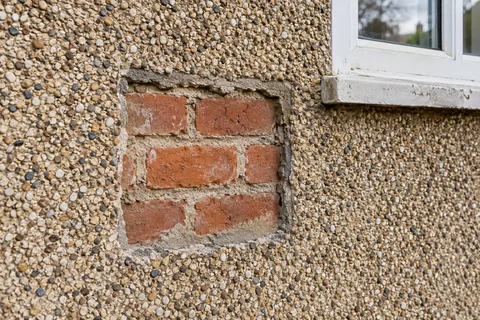
Pebbledash removal strips a dashed finish, meaning the stones, the coat they sit in and usually the base coat, back to the wall. On a York house the bigger questions are what that wall is and what should cover it next. Rough removal can damage the face of older brick or stone, and the revealed wall is seldom fit to be left bare.

On this page
Reasons to strip it
Strip dash when it is failing: when large areas sound hollow, when it bulges or is cracked through, when stones are dropping and water is getting behind, or when layers of paint on it are flaking. Many owners also want rid of dash to get a smooth modern finish or a more traditional one, and that can only be done by taking it off.
If the dash is sound, there are smaller options. It can be coated with a suitable masonry finish, or re-dashed in a new colour: K Rend's overcoating dash receiver is made to go over existing dry dash without a new base coat. Both keep a covering that is still protecting the wall.
- Trial area A small patch is taken off to see how well the dash is bonded and what lies beneath.
- Removal Dash and backing render are hacked off to masonry or to a sound backing coat.
- Clear and dispose Debris is bagged or skipped; this is heavy, dusty and noisy work.
- Repair the masonry Exposed bricks, blocks and joints are repaired before anything new goes on.
- New render system The wall is rendered with the chosen system, or left as fair-faced masonry if suitable.
The usual order of work. The survey and the chosen products decide the actual steps.
Care on older walls
Dash on a Victorian or Edwardian terrace may sit on soft brick laid in lime mortar. SPAB's guidance on removing hard coatings applies: try a small area by hand first, use a hammer and chisel rather than levering off big sections, and leave power tools to very experienced hands. A breaker that does no harm on modern blockwork can take the face off soft brick.
In a conservation area, changing a dashed house to smooth render or exposed brick alters its appearance. York's council says cladding walls needs permission in most cases, unless it repairs or renews an existing surface. Describe the existing finish and the one you want when you ask, and check whether an Article 4 direction covers the street.
The removal process
A tap test across every elevation maps hollow and sound areas, and a trial patch shows how the dash comes away and what lies behind it. Downpipes, cables and fittings are taken off, windows, doors and the path are protected with boards and sheeting, and the render is broken off from the top down and taken away in bags or down a chute.
The bare wall is brushed down, decayed bricks and joints are repaired, in lime on an older wall, and a wet wall is left to dry. If the old dash bridged the damp-proof course, the new render stops above it. On a terrace, stripping stops at the boundary with the neighbour, whose finish needs protecting.
Tap test and trial patch
Fittings off; windows, path and neighbours protected
Break off dash and base coat from the top
Brush down; repair bricks and joints
Let the wall dry; check the DPC
Apply the new render system
What to put back
Behind dash there may be brick that was never chosen to be seen: mixed colours, patched joints, filled openings and cut-back features. Left bare, it can look raw, and on an older wall the brick may have relied on its covering for protection. Plan for a new finish unless the trial shows otherwise.
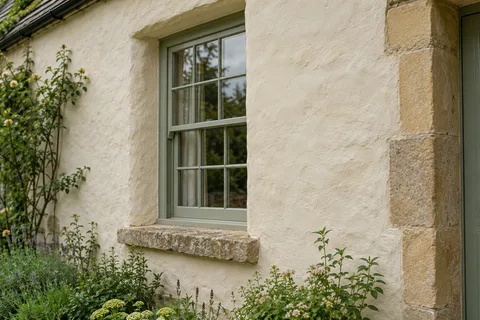
The new finish depends on the wall. Older solid brick or stone usually suits lime render finished with limewash. Modern brick or block can take a cement-based or silicone system. Either way, the trial patch has shown the background, so the specification can be written for the wall you actually have.
Dust, noise and waste
Removal is noisy and dusty, and a whole elevation produces a lot of rubble. Expect windows on that side to stay shut while it is stripped and the path or front garden to be out of use. If scaffold has to stand on the street, the scaffolding company needs a York licence with five working days' notice, and the council's terms mention a separate skip permit where a drop-body skip is used.
Keep photographs of the stripped wall. They record openings, repairs and materials that the new render will hide, which helps anyone working on the house later.
Common questions
Can I expose the brick and leave it?
Sometimes, if the trial shows good, consistent brick in sound condition. But brick behind dash may never have been meant to show, may be patched and may have relied on the covering. Decide after the trial, not before.
Does removing pebbledash cause damp?
Not in itself, but a stripped wall can stay wet for a while, especially if the dash was cracked. Let it dry before new render goes on, and make sure the new render does not bridge the damp-proof course.
See housing and planning information for York and nearby places, including the source and geography behind each figure.