Render repair
Render repair in York
Render repair means cutting out damaged render, putting right whatever damaged it, and rebuilding the area so it matches the wall in material, thickness and texture. In York the material question comes first: an old lime-rendered wall and a modern cement-rendered one need different repairs, and the wrong patch can do more harm than the crack.

On this page
Mapping the damage
Start from the ground. Cracks, bulges, dark patches that stay wet and places where the surface has fallen away show where to look. Then tap: render that has come away from the wall sounds hollow, and IHBC uses exactly that test to find bulging, detached patches. Chalk the outline of the hollow area, because that is the repair, and it is often much bigger than the crack.
Note the direction and shape of each crack. K Rend distinguishes structural cracks, settlement and shrinkage cracks, stress cracks around window and door openings and surface hairline cracks. Long cracks running one way across a wall can indicate movement in the building, which IHBC says should be investigated before the render is repaired.
- Map the damage Tapping finds hollow areas; cracks and their likely cause are noted.
- Cut back Failed render is cut out to a sound edge, usually squared off.
- Fix the cause Leaking gutters, sills without drips or render below the DPC are dealt with.
- Rebuild in coats Using a material compatible with the surrounding render and masonry.
- Blend the finish Texture is matched; colour may need a coating over the wider area.
The usual order of work. The survey and the chosen products decide the actual steps.
Is it lime or cement?
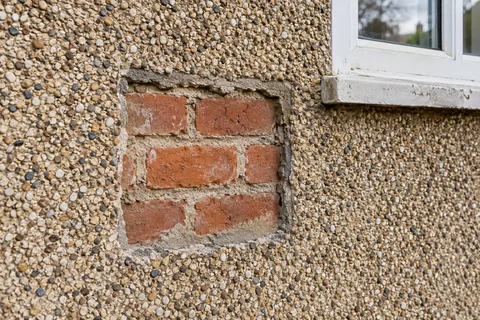
An older York wall may carry lime render, a later cement render over older work, or a patchwork of both, and which it is decides the repair. IHBC says cement and strong hydraulic lime should never be used to patch weak historic lime, and SPAB explains that hard cement traps moisture in older walls. The repair material should match the wall, not whatever is nearest to hand.
If nobody knows, a small sample can be taken for analysis before the repair is specified. On a listed building, check with the council before cutting out historic render, because listed building consent covers alterations to the whole building, inside and out.
Cause first, then the patch
A patch over an unsolved problem fails again in the same place. Look above the damage: SPAB notes that gutters fracture where bolt fixings rust and downpipes leak at their joints, and that render can fail locally where water concentrates. Look below it as well: render running down over the damp-proof course, or ground built up against the wall, keeps the base wet.
With the cause dealt with, the damaged render is cut back to sound material, the wall behind is repaired and dampened or primed as the material needs, and the patch is built up in coats to the surrounding thickness. A lime patch is protected from fast drying like any new lime work. The texture is matched by hand, and K Rend advises leaving active cracks to stabilise before they are repaired.
Map cracks and hollow areas; photograph them
Identify the render type and the water source
Repair the gutter, sill or base detail
Cut out to sound render; repair the wall behind
Rebuild in matching material and coats
Match the texture; cure and protect the patch
Will the repair show?
Probably, at first. New render is cleaner than weathered render, and through-coloured modern renders show differences of shade most. If the wall is painted or limewashed, redecorating the whole elevation afterwards hides a repair far better than spot-painting the patch.
Decide what matters more to you: keeping as much original render as possible, or a uniform look. On a historic building, a visible but honest repair to sound old render is usually preferable to stripping; on a modern house you may prefer to recolour the elevation once the repair has cured.
When repair stops being the answer
If hollow areas cover most of an elevation, or new cracks appear as fast as old ones are fixed, the render has reached the end of its life, and renewing the face as wall rendering may make more sense than patching. On older buildings, remember IHBC's advice that limited detachment which is not getting worse is often best left alone.
Keep a record of each repair: where it is, what material was used and what caused the damage. If the same area fails again, that record shows whether the cause or the repair was at fault.
Common questions
Can I repair render myself?
Hairline cracks in painted modern render can be filled and repainted, but hollow areas need cutting out, and any work above ground needs safe access. On an older lime wall, use lime, not a cement-based filler.
Why has my repair cracked again?
Often because the cause was not dealt with, or because the patch was harder than the wall around it. A cement patch in lime render, or a patch below a leaking downpipe, is likely to fail again.
See housing and planning information for York and nearby places, including the source and geography behind each figure.