Lime rendering
Lime rendering in York
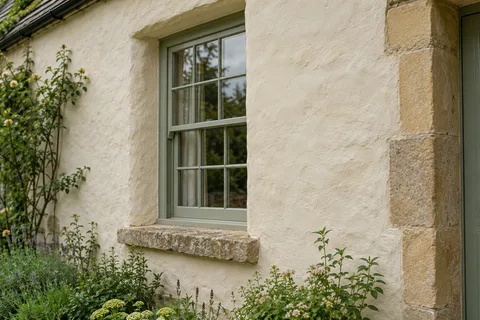
Lime render is the traditional covering for York's older walls: soft, porous and made without cement. It lets a solid wall of brick, stone or timber framing dry out through its face, which a modern cement render does not. In a city with this much historic fabric it is often what the building needs, even though it is slower and fussier to apply.

On this page
Why York's older walls need lime
The council's appraisal of the historic core describes a harmony of materials: plaster and timber, brick and magnesian limestone. Older walls like these depend on moisture leaving through their surface. SPAB's guidance explains what goes wrong when a hard cement render is added: it is more rigid than the wall, hairline cracks form and draw water in, and the cement then holds that water in the fabric.
SPAB singles out timber-framed and earth-built structures as the most vulnerable, because moisture building up behind cement can cause major structural damage. Cement on older walls also tends to fail in patches and come away, whereas a permeable lime render erodes gradually and evenly. That difference is why lime is the repair to choose.
- Stone or brick masonry Cleaned of loose material and dampened so it does not draw water out too fast.
- First (scratch) coat Often haired; scratched to give the next coat a key.
- Second (floating) coat Applied once the first has firmed up; follows the line of the wall.
- Finish coat Thin final coat, kept damp and shaded while it cures.
- Limewash or mineral paint Optional decoration that keeps the wall permeable.
Wall on the left, finish on the right. Not to scale: coats, thicknesses and primers follow the chosen manufacturer’s system and the condition of the wall.
Removing a cement render safely
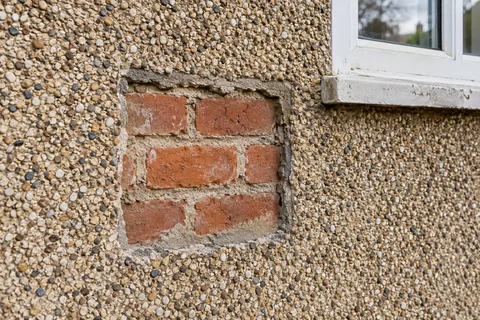
If the wall is already covered in cement, taking it off is the risky part. SPAB recommends removing a small trial area first, by hand with a hammer and, where needed, a chisel. Large sheets should not be levered off, because the soft face of brick or stone can come away with them, and power tools are only for very experienced hands. Firmly attached, sound cement is sometimes left to weather.
Once stripped, a saturated wall should be left to dry before re-rendering, and decayed backing made sound. Salts in the wall can move into new lime, and SPAB warns that re-rendering may be needed after a couple of years. On a listed building, remember that protection extends to the whole building, inside and out, and alterations affecting its special architectural or historic interest need listed building consent.
Coats, curing and weather
Lime is built up in layers. After a stipple or bond coat on dense stone or hard brick, a coarse coat fills hollows, a base coat follows and a finishing coat is floated or roughcast; K Rend's K Lime range shows the pattern. Lime Green asks for the wall to be misted about half an hour before rendering and suction-tested, and warns that lime render should not straighten an uneven wall: one or two coats correct only about 5mm under a 2m straight edge.
Curing is where lime work succeeds or fails. Cornish Lime explains that rapid drying causes cracking, with plastic shrinkage showing within 48 hours, and that each backing coat must set before the next goes on. Hessian hung close to the wall for at least two weeks, kept damp in warm weather, slows the drying. Hot sun and drying wind are as much a threat to fresh lime as cold.
Trial-remove cement by hand; let the wall dry
Repair decayed brick, stone and joints in lime
Mist the wall and test suction
Bond or stipple coat where key is poor
Coarse, base and finishing coats, each allowed to set
Hessian kept on for at least two weeks; limewash when dry
Patching and choosing the lime
Patch lime with lime. IHBC guidance says cement and strong hydraulic lime should never be used to repair weak historic lime, and that bulging, hollow areas can sometimes be consolidated by a conservator rather than cut out. A new patch will look different from weathered work at first; limewashing the whole elevation draws old and new together.
Choose the lime to suit the wall. SPAB advises against strong hydraulic limes on vulnerable fabric and suggests natural hydraulic lime without additives, or lime with a pozzolan such as dust from soft, low-fired bricks, where a quicker set is needed. Your surveyor should explain which lime is proposed and why.
Finishing and maintenance
Limewash is the traditional finish, and SPAB's preferred one, because it is highly permeable. Most modern masonry paints are less permeable and risk trapping moisture in the wall. IHBC adds that limewash should not be patched or overpainted with other paints: it is renewed as it wears, with more limewash.
Look after the water around the wall. SPAB's advice on rainwater fittings is to clear gutters after the autumn leaf fall and check them for leaks in heavy rain, because concentrated wetting breaks down mortar and render locally. IHBC suggests a look from the ground every year and a closer survey about every five years.
Common questions
Can lime render be painted with masonry paint?
It can be, but it undermines the reason for using lime. SPAB warns that standard modern paints usually have lower permeability and risk trapping moisture. Limewash, or a mineral paint made for lime such as K Rend's K Lime Mineral Paint, keeps the wall breathable.
Is lime render suitable for a new extension?
It can be applied to new masonry, but Lime Green asks for new walls to cure for at least 28 days first and advises consulting before using its products on some lightweight blocks. A modern system on the extension and lime on the old house is a workable combination, provided the junction between them is designed.
See housing and planning information for York and nearby places, including the source and geography behind each figure.