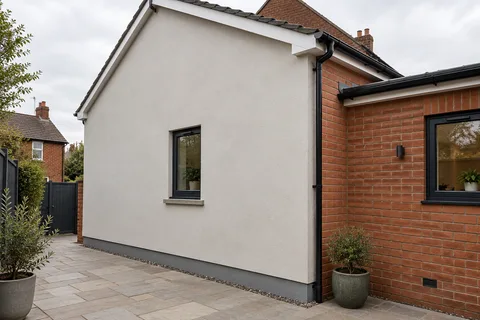
Monocouche rendering
Monocouche rendering in York
Monocouche is a cement-based render coloured right through, applied in one thick coat, typically by spray, and scraped once it has firmed up to leave a fine textured surface. It is a new-build and extension finish: quick to apply on sound blockwork and never needing paint. On York's older walls it is usually the wrong material.

On this page
The material in numbers
K Rend's data sheet for K Mono shows what a monocouche involves. It is cement based and polymer modified, sprayed on at about 17–18mm, levelled at once with a straight edge, and left between 3 and 24 hours, depending on the wall and drying conditions, before scraping. After scraping it should be at least 15mm thick; the nominal finished thickness is 16mm, and the total should stay between 15 and 25mm.
The scraped surface exposes coloured aggregate, so there is no paint layer to peel. A roughcast version is sprayed in two passes, the second one to two hours after the first, and an ashlar pattern can be cut into a scraped face, provided at least 15mm of render remains behind each cut. Other brands differ, so the named product's sheet is what counts.
- Background Usually blockwork or brick; uneven or mixed walls may need a levelling coat.
- Beads and mesh Beads at corners, reveals and the base; mesh over junctions and lintels.
- Monocouche passes One through-coloured material, applied in passes to the specified thickness.
- Scraped surface Scraped once partly set, which removes the skin and leaves the texture.
Wall on the left, finish on the right. Not to scale: coats, thicknesses and primers follow the chosen manufacturer’s system and the condition of the wall.
Where it fits and where it does not
K Rend designed K Mono for moderate to low strength blockwork, and that is its natural home: new extensions, garages and new houses where a coloured render is part of the design. It can also cover a modern cavity-walled house once failed render has been removed and the background prepared.
It should not go on timber-framed walls, limestone, soft old brick or anything that has been lime-rendered. SPAB's warning about cement renders on older walls applies to a cement-based monocouche too: a rigid, dense coat over a permeable wall restricts evaporation. On a listed building or in a conservation area, a monocouche extension also needs the council's agreement on appearance.
The scraping day
Getting the texture even is the hardest part. The coat is ready when a thumb impression cannot be made and the aggregate scrapes away without sticking to the scraper. K Rend says every area must be scraped at the same stage of readiness, because early scraping darkens the colour and late scraping lightens it; the surface is then brushed down with a soft brush.
That is why large walls are planned around bead lines and corners, and why crew size matters. A face that sets faster in sun than in the shade of a neighbouring building can show banding. Weather limits are strict: no application below 5°C or above 30°C, none with frost forecast within 24 hours, and none onto an elevation in direct sunlight.
Blockwork complete, clean and sound
Beads at corners, reveals and above the DPC
Mesh at opening heads and stress points
Spray to about 17–18mm and rule flat (K Mono)
Scrape the whole face at one stage of set; brush down
Protect from rain, frost and strong sun
Old meets new
In an older city, most monocouche meets older work somewhere: the brick of the original house, a lime-rendered neighbour, a stone sill. Stop it on a bead at the corner or a designed joint rather than taking it onto old fabric, and keep the damp-proof course clear; K Rend's detailing sheet asks for the DPC to project past the face of the render.
Choose the colour against what is actually there. A bright white beside weathered brick or limestone can look harsh. K Rend recommends a site sample panel to check colour and texture and warns that natural materials can vary slightly in shade, so order enough for a whole elevation at once where possible.
Looking after it
Scraped render needs little more than an occasional clean. Treat green growth with a biocide, then wash gently with a wide-fan pressure setting and mild detergent, top to bottom, as K Rend advises; a high-pressure jet can damage the surface. Keep downpipes sound, because a leaking joint streaks a pale render quickly.
If the colour fades or patches show after repairs, K Rend's Colour Enhance is designed to refresh existing scraped render with two coats by brush or roller once the wall is sound, clean and free of algae. That keeps the texture while evening out the colour; see render respray for how coatings are chosen.
Common questions
Does monocouche crack?
It can, especially at the corners of windows and doors where stress concentrates, which is why mesh is embedded there. Hairline surface cracks are mostly cosmetic; wider ones should be inspected.
Can monocouche be applied by hand?
Yes. K Mono is designed for spray machines but can be hand-mixed with 5–5.5 litres of water per 25kg sack, although coverage may be lower by hand.
See housing and planning information for York and nearby places, including the source and geography behind each figure.