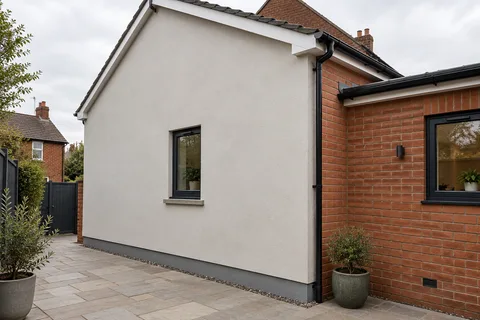
Silicone rendering
Silicone rendering in York
Silicone render is a modern thin-coat finish: a ready-mixed, through-coloured paste between about 1.5 and 3mm thick in K Rend's range, laid over a reinforced base coat. It repels rain and stays clean, which suits new extensions, rebuilt walls and insulated façades. In York the important question is where not to use it, because much of the older stock needs a softer, more permeable finish.

On this page
What goes on the wall
A silicone system has more parts than its name suggests. The wall is prepared and beaded, then a polymer-modified base coat is applied with alkali-resistant mesh bedded in it, particularly around windows and doors. After that comes a primer tinted to the finish colour, and finally the silicone coat. In K Rend's Silicone TC, that top coat is spread to the depth of its largest grain: 1.5mm for TC15, 3mm for TC30.
The finish itself blends silicone resin with acrylic, contains no cement, and in K Rend's version includes a biocide against mould and algae. It sheds rain while letting water vapour through, and it has a low tendency to pick up dirt. Those properties suit a solid modern background; they do not make it a substitute for lime on a traditional wall.
- Sound background A background accepted by the specified system. Keeping old render requires a system-specific assessment of its bond and condition.
- Beads Corner, stop and base beads set the edges and straight lines.
- Basecoat with mesh Glass-fibre mesh embedded in the basecoat resists cracking.
- Primer Where the system requires it, tinted towards the finish colour.
- Silicone finish A thin, through-coloured, water-repellent coat that forms the texture.
Wall on the left, finish on the right. Not to scale: coats, thicknesses and primers follow the chosen manufacturer’s system and the condition of the wall.
Where it belongs on a York property
Typical uses are a new rear extension in block, a rebuilt gable, a post-war house whose cement render has failed, and insulated walls, where a thin finish is needed over the boards. K Rend lists blockwork, brick, sand-and-cement render, concrete, render boards and EWI panels as suitable backgrounds after preparation.
Keep it off historic fabric. A timber-framed, limestone or soft-brick wall that has always been limewashed or lime-rendered depends on drying through its face, and SPAB recommends lime for such walls. In one of York's 35 conservation areas, or on a listed building, switching from lime or exposed brick to a modern silicone finish would also need the council's agreement.
Sequence on site
After old render is removed or a sound surface is cleaned, beads are fixed and the base coat with mesh goes on. K Rend's data sheet asks for at least 14 days before the thin coat is applied to a fresh base coat, then 24 hours for the primer to dry. That gap is normal; it is not the job stalling.
The thin coat is laid on with a stainless steel float to the depth of the grain, allowed to take up slightly, then rubbed in small circles with a plastic float to form the texture. Each face is worked to a wet edge from one end to the other. Joints are planned at corners or downpipes, because a stop in the middle of a wall shows for good.
Strip or clean, and repair the background
Beads at corners, reveals and the DPC
Base coat with mesh; 14 days minimum (K Rend Silicone TC)
Tinted primer; 24 hours
Thin coat to grain depth, textured with a plastic float
Each elevation completed to a wet edge
Weather, and the junction with older work
K Rend's sheet sets a 5°C minimum for air and wall, rules out strong sun, strong wind and damp or frozen walls, and asks for the fresh finish to be kept from rain and from drying too fast. In a tight York street with scaffold on the footway, sheeting does double duty: it protects the fresh finish and the people walking underneath.
Where a silicone-rendered extension meets an older lime-rendered or brick house, form a clear break, such as a stop bead at the corner or a recessed joint, rather than running the silicone onto the old wall. The two materials behave differently, and a defined junction lets each be maintained in its own way.
Care and maintenance
K Rend's maintenance advice is a gentle wash after a few years: clean water with mild detergent, a pressure washer on a fan setting rather than full power, from the top down, with algae treated by a biocide first. K Rend notes that walls near trees and other sources of spores grow algae soonest.
Use stainless steel brackets for anything fixed later, because rust from cheap fixings streaks the finish. Keep the product, grain and colour reference with the house papers. If you want a different colour later, a compatible coating can go on, but that is a recolouring job in its own right.
Common questions
Is silicone render breathable?
K Rend says its Silicone TC lets water vapour pass while repelling rain. That is not the same as the open, absorbent behaviour of lime on an old wall, which is why SPAB recommends lime for traditional buildings.
Can silicone go over old pebbledash?
Not directly. The dash has to be removed or levelled with a base coat first, because a 1.5mm finish follows every bump beneath it.
See housing and planning information for York and nearby places, including the source and geography behind each figure.