York rendering guide
Questions to ask when comparing lime-render quotations
Two quotations for lime render can describe very different jobs under the same heading. One may repair patches in a sound lime finish; another may strip the whole wall and render it from scratch. Even when the scope matches, the lime, the coats, the curing and the finish can differ. Knowing what a lime specification should name makes the comparison straightforward.

On this page
Same heading, different jobs
For example, imagine two hypothetical offers for the same York elevation. Offer A repairs three hollow areas in lime, cuts out two old cement patches and limewashes the wall. Offer B proposes complete removal of the render, repairs to the brick and three new coats of lime with a limewash finish. Both say lime rendering, but B is a far larger intervention.
Which is right depends on the wall. If most of the render is sound, A is the proportionate answer, and IHBC advises that limited detachment that is not worsening is often best left alone. If most of it is hollow or it is cement, B may be needed. A sentence such as lime is breathable says nothing about which scope the wall needs; ask each contractor to explain the reasoning.
What the specification should name
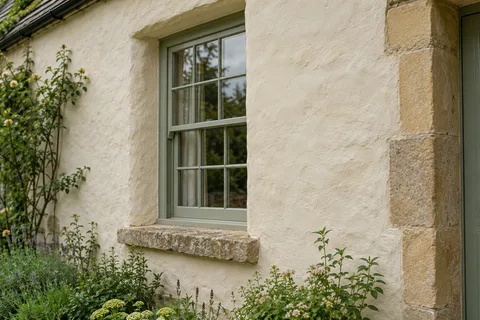
The lime itself: SPAB recommends a weaker, more permeable lime render without cement and advises against strong hydraulic limes; where a quicker set is needed it suggests a natural hydraulic lime without additives or a pozzolan such as brick dust. The coats: a bond or stipple coat where key or suction is poor, dubbing-out coats on an uneven wall, a base coat and a finish, as K Rend's K Lime range illustrates, each left to set before the next.
The finish: floated, or roughcast thrown with aggregate; K Rend's lime roughcast, for example, is mixed with 4–8mm limestone chips. The decoration: limewash, which SPAB prefers, or a mineral paint made for lime. If a quotation names none of these, ask for them in writing before comparing prices.

Preparation and curing
Lime Green's guidance sets out the preparation a good quotation should allow for: a clean, sound background, misting about half an hour before rendering, a suction test, stipple coats on dense surfaces, and only stainless steel lath where a carrier is needed. It also warns that lime render should not be used to correct gross irregularities, so an uneven wall may need separate dubbing out.
Curing should be priced as part of the job, not left out. Cornish Lime recommends hessian kept close to the fresh render for at least two weeks, dampened in warm weather, and suggests fibres in base coats on high-suction backgrounds to limit shrinkage cracking. Ask how each offer protects the work from sun, wind, rain and frost.
Removal method
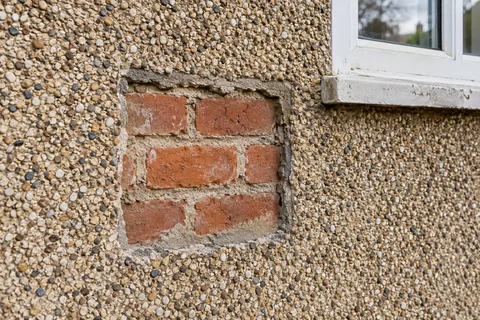
If old render or cement is coming off, the method matters as much as the new lime. SPAB recommends a small trial first, hand tools with great care, no levering off of large sheets, and power tools only in highly experienced hands. It also warns that a saturated wall should be allowed to dry before re-rendering and that salts may affect new lime in the first couple of years.
Ask each contractor how they will remove the render, what they will do if the brick face comes away and who will decide whether to continue. One offer that includes a trial and a review point is easier to trust than one that assumes the whole wall will strip cleanly.
Allowances, exclusions and access
A fixed item is work included on stated assumptions; an allowance covers work whose extent is not yet known, such as brick repairs found after stripping; an exclusion is work left out. Line the offers up under the same headings and check that the same tasks appear in each, even if one contractor treats something as an allowance and the other as fixed.
Check access the same way. If scaffold has to stand on the highway, York requires a licence obtained by the scaffolding company with five working days' notice, and a temporary footway if people cannot pass through. Lime work, with its curing time, may keep scaffold up for longer than a cement job, so ask how long each offer assumes.
Questions to send to both contractors
Which lime will you use, and why that one for this wall? How many coats, and how thick in total? How will you prepare the wall, and what will you do on areas with poor key or high suction? How will the render be cured and protected, and for how long? What finish goes on, and when? How will old render or cement be removed, and what happens if the masonry is damaged?
Send the same list to each, and ask for written answers. The answers will often reveal more about the two offers than their totals do, and they give you a specification to hold the chosen contractor to. Vague answers to specific questions are a warning sign in themselves.
Making the choice
Once the offers are in the same format, the differences are clear: scope, materials, curing, removal method and access. Ask both contractors the same clarification questions and keep their answers with the revised quotations. Do not stitch parts of two different methods into one job; ask for a single coordinated proposal instead.
The York rendering overview gives the wider context for repair and replacement. Whatever the choice, keep the final specification, the lime used and the finish with the house records, so later repairs use the same materials.
Common questions
Does a more detailed quotation mean a better contractor?
Not by itself, but it makes the proposal easier to check. Look for named materials, a clear method and a curing plan, and ask for references for similar lime work.
What if a quotation includes a provisional allowance?
Ask what it covers, what would make it firm and how changes will be agreed. It should relate to a real uncertainty, such as brick condition behind the render.
Should lime render be finished with masonry paint?
SPAB advises against it, because standard modern paints are usually less permeable than limewash and risk trapping moisture. A quotation that ends in ordinary masonry paint is worth questioning.
See housing and planning information for York and nearby places, including the source and geography behind each figure.